
The following quote is by Elder Quentin L. Cook. It was given in the October 2016 General Conference of The Church of Jesus Christ of Latter-day Saints.
“While there are many examples of looking beyond the mark, a significant one in our day is extremism. Gospel extremism is when one elevates any gospel principle above other equally important principles and takes a position that is beyond or contrary to the teachings of Church leaders. One example is when one advocates for additions, changes, or primary emphasis to one part of the Word of Wisdom. Another is expensive preparation for end-of-days scenarios. In both examples, others are encouraged to accept private interpretations. ‘If we turn a health law or any other principle into a form of religious fanaticism, we are looking beyond the mark.’”
The General Handbook of The Church of Jesus Christ of Latter-day Saints states, in section 38.8.16
“…Church leaders have counseled against extreme or excessive preparation for possible catastrophic events. Such efforts are sometimes called survivalism. Efforts to prepare should be motivated by faith, not fear.”
Considering this quote and the handbook statement, it seems appropriate to repeat this post originally made in 2014:
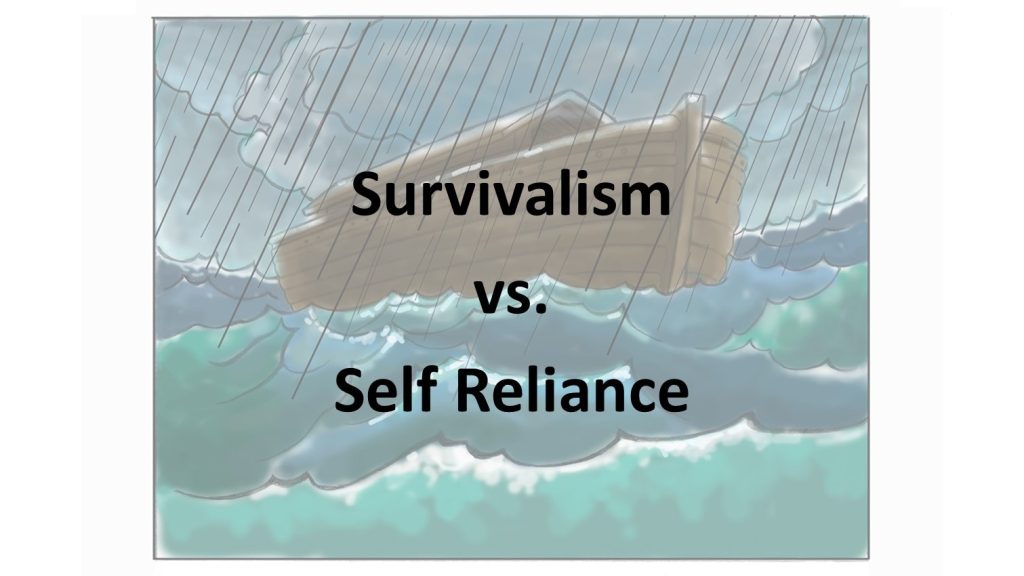
Survivalism vs. Self-Reliance
I recently (2014) attended a Self-Reliance Expo. There was a lot of good information there but only about half of it was a self-reliance expo. The rest was a survivalism expo. I thanked one of the vendors for coming because they really did support and teach self-reliance and not survivalism. What’s the difference? A lot, but the differences can be very subtle. It’s the mindset, the attitude, the reason for doing very similar, if not the same, things.
Survivalism is the skills to use “survival” equipment. Self-reliance is life skills and equipment. Survivalism is preparation for a 1-time occurrence. Self-reliance is preparation for life. Survivalism is freeze-dried food only. Self-reliance is knowing how to grow, can, and dehydrate your own food. Survivalism is isolationist. Self-reliance is community. Survivalism is preparing for panic. Self-reliance is preparing for peace.
| Survivalism | Self-reliance |
| Freeze dried food only | Whole basic foods such as grains, legumes, dry milk, etc. |
| Freeze dried and dehydrated pre-made meals | Knowing how to make meals from stored ingredients |
| Freeze dried fruit only | Home grown, home dehydrated and home canned fruit |
| Freeze dried vegetables only | Home grown, home dehydrated and home canned vegetables |
| Freeze dried soups, stews, casseroles | Home canned soups, stews, “instant” meals |
| Freeze dried meats only | Home raised and home canned meats |
| Powdered eggs | Raising chickens or cooking without eggs |
| Long term food stores only | Seeds for growing more food |
| Inexpensive hand grain grinder | Quality grain mill for regular use |
| Solar cooking for power outages | Solar cooking to save money and energy which can also be used in an emergency |
| Camping and hiking gear for bugging out | Camping and hiking gear for family vacations which can also be used in an emergency |
| Hoarding | Using stored food regularly |
| Foraging to survive | Foraging to save money and eat local |
| Emergency medical treatments | Essential oils, herbal medicines, everyday medical treatments |
| Survival equipment skills | Living skills |
| Preparing for a 1-time occurrence such as Y2K | Preparing for life |
| Justifying extreme measures | Moderation |
| Static | Active and ongoing |
| Selfish | Sharing, helping |
| Isolation | Community |
| Preparing for panic | Preparing for peace |