
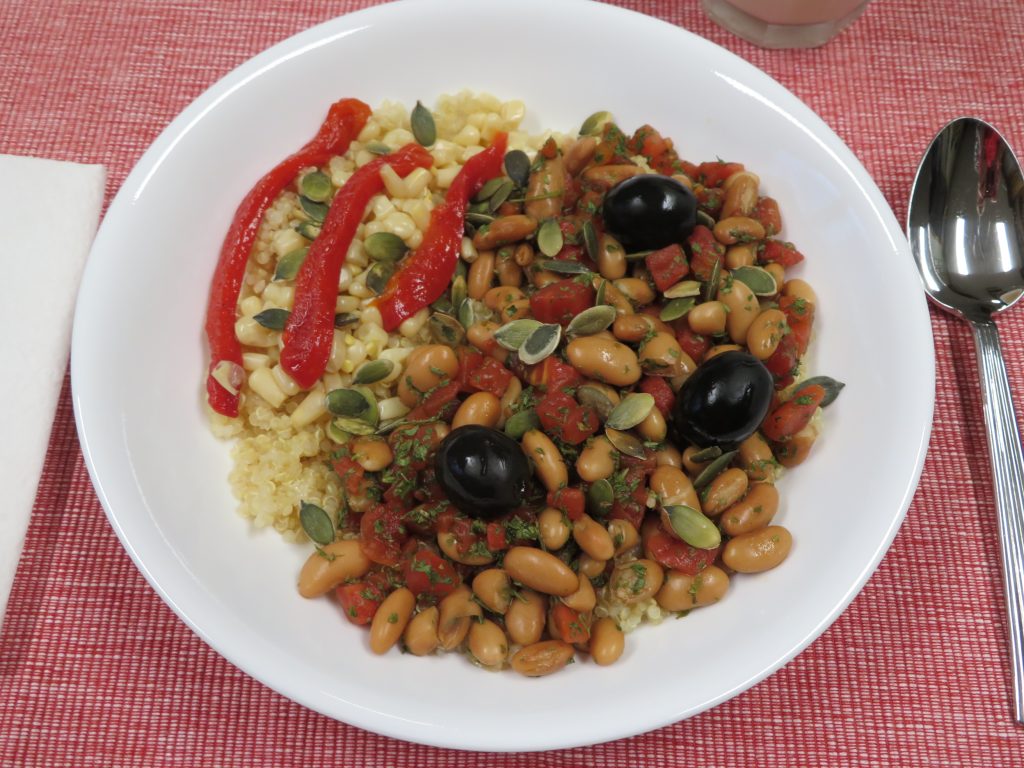

In 2014, I watched beef prices soar, and pork and chicken prices begin to rise, also. When I saw hamburger advertised for $4.50/pound, I wondered if the time had finally come when quinoa was a less expensive protein source than meat. I decided to check it out.
I went to my local HEB grocery store and to Costco to get a general idea of prices and then figured out the cost of protein equivalents providing approximately 14 grams of protein. The daily recommended amount is 46 to 56 grams per day for teens and adults. (BTW, there are many stores with higher prices than HEB so I did not see the high end of the cost during this analysis.)
With the price of eggs again soaring and meat and chicken prices still high, I decided to make the comparison, again, not only to compare complete protein grains but to compare high priced eggs.
Here’s what I found in February 2025:
| Food | Amount ready to eat | Amount of protein in grams | Amount to purchase | Cost at HEB and cost per gram of protein | Cost at Costco or Sam’s and cost per gram of protein | Azure Standard and cost per gram of protein |
| Dry Pinto beans | 1 cup | 14 | 3 oz. dry | .15 or .01/g | .15 or .01/g | .27 or .02/g |
| Beans, canned | 1 cup | 11.6 | 1/2 of a 15.5 oz. can | .43 or .04/g | .50 or .04/g | |
| Peanut butter | 4 tablespoons | 14 | 2 oz. | .22 or .02/g | .22 or .02/g | |
| Cheddar cheese | 1/2 cup | 14.2 | 2 oz. | .54 or .04/g | .38 or .03/g | |
| Eggs, large | 2 | 12.4 | 2 | .90 or .07/g | .72 or .06/g | |
| Tuna | 2 oz. | 14.6 | 1/2 of a 5 oz. can | .50 or .03/g | .36 or .02/g | |
| Chicken breast1 | 2 oz. | 17.8 | 1/5 lb. or 3 oz. | .57 or .03/g | .60 or .03/g | |
| Chicken breast, canned2 | 2 oz. | 12.4 | 3 oz. | .81 or .07/g | .48 or .04/g | |
| Ground beef, 85-88% | 2 oz. | 13.7 | 1/5 lb. | 1.06 or .08/g | .92 or .07/g | |
| Amaranth | 1-1/2 cups | 14 | 4 oz. | .42 or .03/g | ||
| Quinoa | 2 cups | 14 | 4 oz. | .99 or .07/g | .56 or .04/g | .62 or .04/g |
| Almonds | 1/2 cup | 14.3 | 2.5 oz. | .93 or .07/g | .63 or .04/g | |
| Whole milk | 2 cups | 16 | 1 pint | .36 or .02/g | .30 or .02/g |
Comparing prices to April 2014 (the last time I did this):
- Canned beans are up in price. (a good reason to learn to can them especially since prices on dry beans are not high. Note the price comparison between dry and canned. If you can them yourself, you get the dry price.)
- Peanut butter and cheese are about the same as in 2014.
- Eggs are 2 to 3 times more expensive.
- Tuna prices vary.
- Raw chicken is about the same.
- Ground beef is a little higher.
- Both quinoa and amaranth have come down in price at all 3 locations.
- Almonds are the same or lower.
- Milk is about the same.
Dry beans, canned dry beans, peanut butter, cheese, milk, and tuna are STILL good protein buys even at current prices. Many are the same or less than chicken breast if you shop for the lowest prices. Ground beef is the most expensive of all the foods listed, even more than eggs. Dry beans are the least expensive followed closely by peanut butter and milk.
Quinoa and amaranth have very competitive protein costs especially when purchased in bulk amounts. Chicken may seem less than the HEB quinoa but that only applies if you use a pound of chicken to feed 8 people. If you buy quinoa at Costco, or for a similar price ($2.22/lb.), it is less than beef and definitely less than a 4-ounce chicken breast or a 4-ounce hamburger.
Even though eggs are very high in price, and similar in price to beef, they are still a less expensive source of protein per serving. Most people won’t eat more than 2 eggs but will eat at least 4 ounces of chicken or ground beef unless they are in soups or casseroles. That’s when you have to look at cost per serving and not cost per 14 grams of protein.
Some other points to note:
- Serving plain meat can double, triple, and quadruple your protein costs, if not more.
- Ground beef is usually the least expensive beef. Regular prices of any other cut will make protein grains and eggs an even better cost choice as a protein source.
- Warehouse stores are not always the least expensive.
- Bulk bins are not always the least expensive.
- Dry beans are usually half or one third the price of canned. That’s a good reason to learn to home can beans.
- Buying meat and poultry on sale definitely lowers the protein price and can make it more competitive with non-meat sources.
- These are all regular prices. Think how much better you will do with sales.
- Two cups of quinoa is a lot more filling than 2 ounces of meat.
- Look at all the good protein sources that are shelf stable! – dry beans, canned beans, peanut butter, canned tuna, canned chicken, amaranth, quinoa, almonds plus many foods not mentioned here.
Bottom line: As a protein source, quinoa and amaranth are cost competitors with chicken and certainly less than beef or when a serving of meat/poultry is more than 2 ounces. Don’t judge alternative protein sources by the cost per pound but by cost per serving. Good protein sources do not have to be expensive and do not have to be meat or poultry. BTW, this is the conclusion I came to in 2014, also.
Bottom line #2: Even when eggs are .45 each, a serving of two eggs is still a lot less expensive than 4 to 6 ounces of chicken or beef. Two eggs may have less protein than 4 ounces of chicken, but daily protein needs can easily be met through additional foods and meals each day.
| 4-ounce chicken breast | $1.14 to $1.20 | 4 ounces of ground beef | $1.84 to $2.12 |
| 6-ounce chicken breast | $1.71 to $1.80 | 6 ounces of ground beef | $2.76 to $3.18 |
| 2 large eggs | $0.72 to $0.90 | 2 large eggs | $0.72 to $0.90 |
1I chose boneless, skinless chicken breast because it is so commonly used and because accounting for the weight of the bone could be inconsistent in the amount to purchase to get 2 ounces of meat. Other forms and cuts of chicken are often less expensive, though.
2Includes broth
Prices as of February 2025 in Spring, Texas.